
Ecommerce builds that start with the business model.
Ecommerce website development for brands that want to grow, not just launch.
Bespoke ecommerce builds on Shopify, Magento, and WooCommerce by a UK full-stack consultant. £10M+ ad spend managed. £2M+ in client revenue generated. 100+ stores shipped.
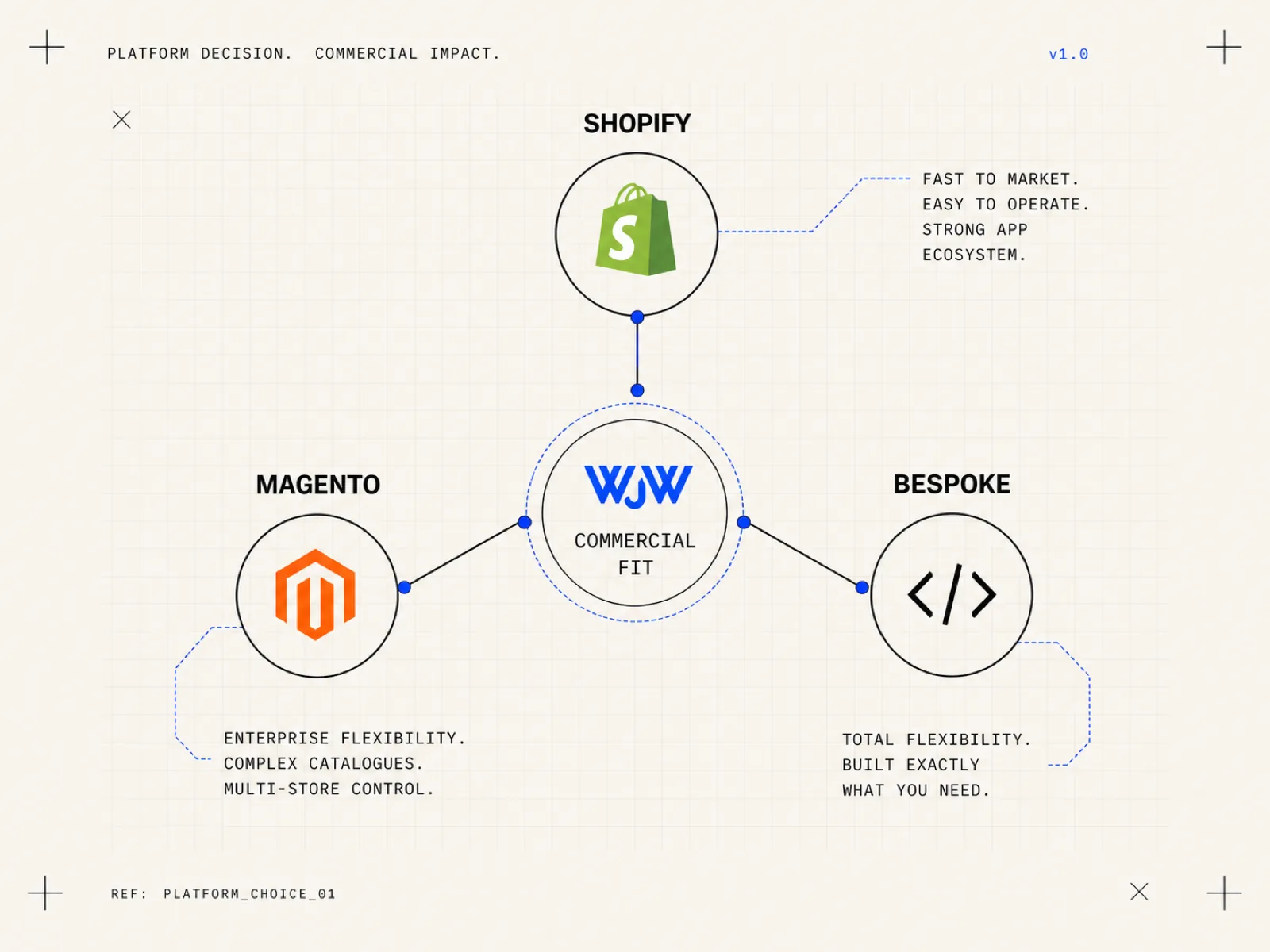
Most ecommerce agencies are platform shops. They sell you Shopify because they only build Shopify, or they push you into Magento because Magento is what their team knows. I have spent 15 years across the major UK ecommerce platforms, and the right answer genuinely is "it depends." It depends on your turnover, catalogue complexity, team capability, integration requirements, and what you are trying to achieve in the next three years.
Discovery starts with platform choice, including the option that you stay on the platform you already use. From there, the build is the same regardless of platform: brand-led design, performance-first development, conversion-aware architecture, and a launch that does not lose your existing rankings.
Platforms I build on
Ecommerce web development should start with the right platform for the business, not the one that happens to be easiest to sell.

Shopify & Shopify Plus
The right answer for most DTC brands and ecommerce businesses under £5m turnover. Hosted, secure, scales without Magento's infrastructure overhead, and a vast app ecosystem covers most needs. Shopify Plus makes sense from £1m+ where Markets, B2B, and Functions earn their keep.
Magento 2 & Adobe Commerce
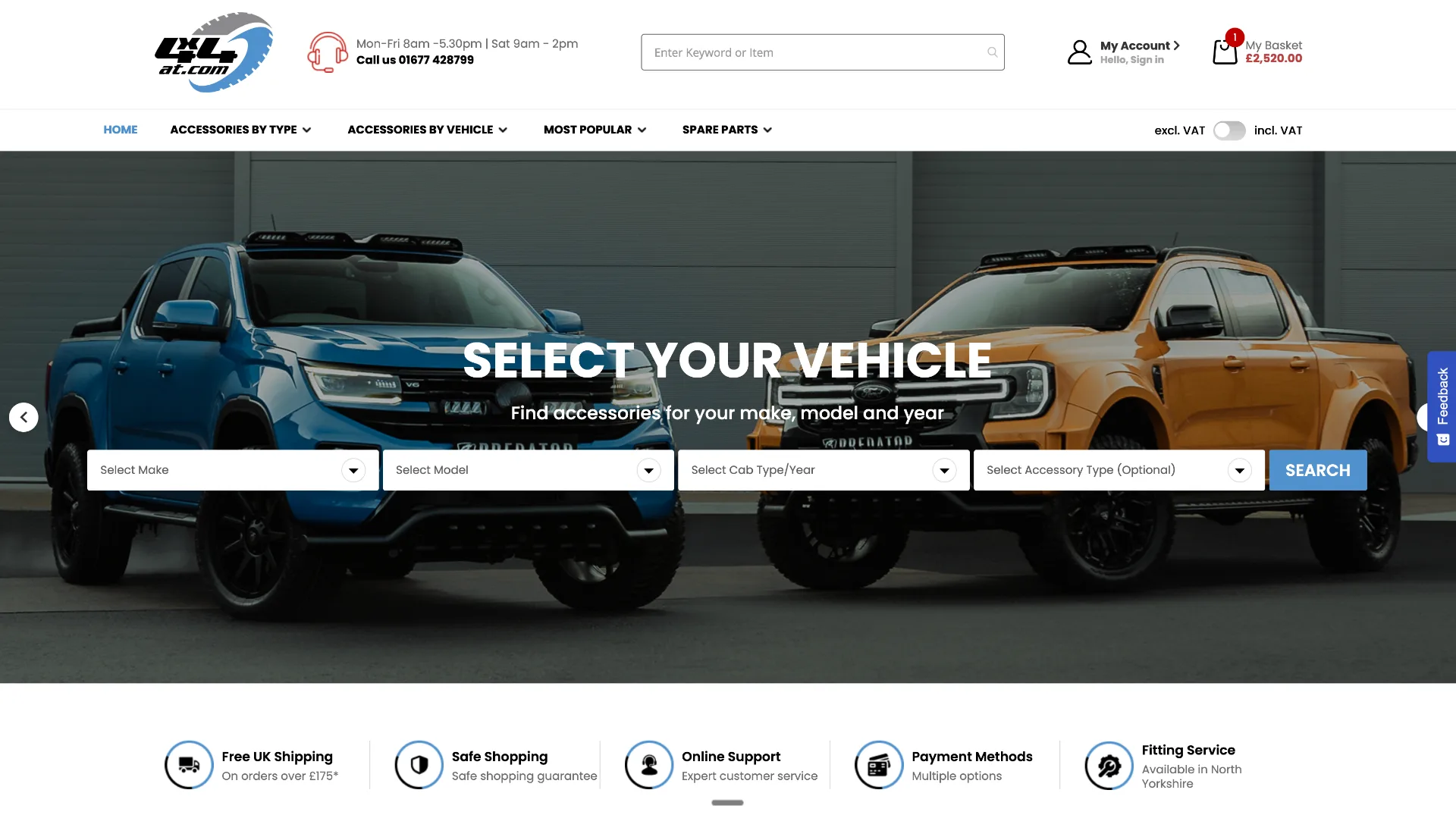
The right answer for complex catalogues, native B2B requirements, multi-store, and businesses at £5m+ turnover where Shopify's flexibility ceiling becomes a constraint. Hyvä themes keep Magento performance realistic instead of theoretical.
WooCommerce
The right answer for content-led ecommerce where the blog, editorial, or brand story is doing as much work as the catalogue. Built on WordPress, so marketing teams get familiar tooling. Best up to mid-six-figure turnover.
How to choose between them
The honest answer to Shopify vs Magento vs WooCommerce is not a universal winner. The winner is the platform that fits your commercial model and does not make your team fight the system every day.
Choose Shopify if:
Your turnover is under £5m, the catalogue is straightforward, you want a hosted platform without infrastructure overhead, and you value speed to launch and ease of management. Shopify Plus extends that ceiling significantly.
Choose Magento if:
Your catalogue is complex, you need genuine B2B features, you run multi-store or multi-currency from one backend, or your integrations go beyond what Shopify apps can do cleanly. The total cost of ownership is higher, so the complexity needs to justify it.
Choose WooCommerce if:
Content marketing is central to the business, you publish regularly, and your team already knows WordPress. WooCommerce inherits WordPress's content strengths without Shopify platform fees, but it is best below mid-six-figure turnover.
Honest caveat: the platform you are already on is usually the right answer in the short term. Migration projects only make sense when the cost of staying outweighs the cost of moving. Discovery includes that assessment, and sometimes the right advice is "do not migrate yet."
What's included in an ecommerce build
The platform changes. The commercial fundamentals do not: design, speed, tracking, payments, retention, and SEO protection.
Brand-led design
Every build starts with design in Figma, signed off before any code is written. Strategic UX work connects brand, product, and conversion rather than leaving you with decorative mockups.
Performance-first development
Lighthouse 90+ targets, Core Web Vitals as launch criteria, and the architectural decisions that keep performance high as the catalogue grows. Fast stores convert better.
Payments, tax, and compliance
Stripe, PayPal, Klarna, Clearpay, GoCardless, UK VAT, EU VAT, GDPR-compliant analytics, and the payment configuration decisions that affect conversion and reconciliation.
Tracking & analytics
GA4, Google Tag Manager, Meta CAPI, and server-side tracking where iOS privacy changes and ad blockers are eating your data. Set up properly so campaigns do not run blind.
Email & retention
Klaviyo as default for flows, segments, and deliverability. Transactional email through Postmark or Resend. Built into the launch plan, not bolted on when retention disappoints.
Migrations & SEO equity
Migrating platforms is not just moving data. URL mapping, 301 redirects, structured data, and internal linking are planned weeks before go-live so existing rankings are protected.
How a project actually works
The same shape applies whether the final platform is Shopify, Magento, WooCommerce, or a more bespoke ecommerce architecture.
Discovery
Platform choice, scope, and a fixed-price phased quote. The first question is whether you should move platform at all, because the platform you are already on is often the right short-term answer.
Design & build
Brand-led Figma design first, then bespoke ecommerce development with weekly progress reviews on a staging environment. Tracking, payments, feeds, and email are configured as the build progresses.
Launch
Coordinated go-live, redirect mapping for migrations, full QA, payment testing, team training, and documentation. The aim is a calm launch with no downtime and no rankings panic.
Growth
Optional retainer covering development, conversion testing, SEO, and paid media. One person who knows the store, the numbers, and the technical decisions behind both.
Recent ecommerce work
A spread across Shopify, Magento, and growth-led ecommerce work where build quality and commercial performance had to support each other.

£30k to £120k/month
A Shopify migration and performance rebuild protected SEO equity while improving speed, UX, and the merchandising tools needed for growth.
Read case study →
+375% online revenue
Magento development, technical SEO, and paid media worked together to grow revenue while keeping the platform stable and measurable.
Read case study →
5.9x ROAS
Store optimisation, retention flows, paid media, and conversion work were joined up around the same data instead of split across separate vendors.
Read case study →Beyond the build
A new ecommerce store earns its keep when the campaigns that drive traffic to it are profitable. That is where most agency relationships fall apart. The build team launches, hands off to a separate paid media team, and the people running ads have no context on the build decisions that made certain pages slow, hard to test, or untrackable.
I run paid campaigns for the stores I build. £10M+ in profitable ad spend across Google Ads, Meta Ads, Performance Max, and Shopping. Average client ROAS: 4.8x. The store is built knowing what conversion campaigns will demand of it from day one: fast pages, clean tracking, structured data, and CRO-ready architecture.
That is the point of working with one consultant rather than three vendors.
Related services and guides
This is the ecommerce pillar page. The deeper platform, growth, and local pages sit underneath it.
Frequently asked questions
Straight answers on ecommerce development, platform choice, migrations, and what happens after launch.
How much does an ecommerce website cost to build in the UK?+
It depends entirely on platform and scope. A Shopify build is a different conversation to a full Adobe Commerce B2B platform with ERP integration. Every Discovery call results in a fixed-price quote tailored to the actual scope, so you know what each phase costs before committing. No day rates quietly running over budget.
Which ecommerce platform should I use?+
Most brands under £5m turnover are best on Shopify or Shopify Plus. Brands at £5m+ with complex catalogues or B2B requirements often need Magento or Adobe Commerce. Content-led brands with WordPress already in place can work well on WooCommerce. Discovery gives you a recommendation based on your actual catalogue, team, integrations, and growth plan.
Can you migrate me from Platform X to Platform Y?+
Yes. I work on Magento to Shopify, Magento 1 to Magento 2, WooCommerce to Shopify, BigCommerce to Shopify, and custom platform migrations. The data move is usually the straightforward part. Protecting SEO rankings, redirects, analytics, order history, and customer continuity is where the real work happens.
How long does an ecommerce build take?+
Shopify builds typically run 6-10 weeks. Magento builds usually run 12-18 weeks. WooCommerce builds are commonly 6-10 weeks. Migrations add 2-4 weeks for data and SEO work, sometimes more if the catalogue or URL history is messy. Discovery gives you a phased timeline based on your actual scope.
Do you also handle SEO and paid media for the stores you build?+
Yes. That is the point of working with one consultant. I have managed £10M+ in profitable ad spend across Google Ads, Meta Ads, Performance Max, and Shopping, with an average client ROAS of 4.8x. Most clients keep me on a retainer covering development plus growth.
Can you work with my existing brand assets and Figma files?+
Yes. Most ecommerce website development projects start with at least some existing brand work. Discovery includes auditing what is useful, what needs tightening, and what needs creating before build starts. If your Figma files are already strong, the project moves faster.
Will I be tied to working with you forever?+
No. Code is delivered into your repo where relevant, platform accounts are owned by your business, and the build is documented for another competent developer to pick up. Most clients stay because they want continuity, not because the project is locked away.
Do you work with brands outside the UK?+
Yes. I work with ecommerce brands across the UK, Europe, North America, and Australia. UK clients get the bonus of being able to meet in person when useful, especially around Harrogate, Leeds, York, and the wider Yorkshire region.
What sectors do you specialise in?+
Premium DTC brands, fashion, furniture, beauty, home, luxury goods, B2B distributors, and specialist retailers. I am less suited to mass-market low-margin retail where the platform decision is driven more by catalogue volume and operational throughput than brand experience.
What is the first step?+
Book a Discovery call from this page. It is 30 minutes, no pressure, and no obligation. We will talk through your platform, catalogue, goals, and whether I am the right person to build it. If there is a fit, I will send a proposal within 48 hours.
Building ecommerce stores that earn their keep.
Book a free 30-minute Discovery call. Honest answer on platform, scope, and whether I am the right person to build it.